The 8th ‘Changamka’ Shopping Festival held in Nairobi
KAM’s Changamka Shopping festival
Various challenges continue facing intra-Africa trade and not least in the East Africa Community (EAC) region. Here, for instance, inadequate logistics infrastructures are being tackled by the member states governments in collaboration with partners such as Trade Mark Africa. “The Kenya to Uganda Malaba border point, for instance, was designed initially to handle 600 trucks but today faces demand from over 2500 trucks daily sometimes leading to trucks pile up of even 20 km as the trucks (trailers and other heavy vehicles await clearance,” explained Dr Juma Mukhwana , the PS (Principal Secretary), State Department for Industry, Trade & Investments at the launch of the 8th Edition of the Changamka (Brighten or Cheers up in English) Kenya Shopping Festival at the Kenyatta International Convention Centre (KICC), Nairobi, on Nov 4th , 2025.
According to Dr Mukhwana efforts are always made to ensure that the pile up does not extend beyond 5 km upon which drastic measures are always undertaken.
The five-day festival, running from 4th November to Saturday, 8th November 2025, was a celebration of Kenyan creativity, resilience, and enterprise under the theme: “Driving Kenya’s Manufacturing Competitiveness through Inclusive, Sustainable Industrialization, Economic Diversification and Trade Partnerships.” It attracted over over 330 exhibitors from across the country & overseas.
The event, organized by the Kenya Association of Manufacturers (KAM) in partnership with the Ministry of Trade, Industry & Investments, is part of the wider ‘Buy Kenya, Build Kenya’ campaign, aimed at promoting locally made products and deepening the country’s manufacturing footprint across the EAC region. According to KAM’s officer Jane Njogu, the event hosted over 330 exhibitors including over 100 SMEs and over 100 big firms. The festival featured exhibitions across various sectors, including textiles, food processing, construction materials, household goods, technology, and renewable energy among others.
Dr. Mukhwana, CBS, highlighted Kenya’s pivotal role in shaping the future of Africa’s industrialization. According to him, Kenya has long been a gateway to East and Central Africa. “Following recent withdrawal of some major support from governments in the developed world, this is the opportune time when Africa should concentrate on her problems; this is our moment to turn challenges into opportunities. We must leverage export opportunities, for when we export Kenyan-made goods, we tell the world that we are not just a market, we are producers, innovators, and exporters,” he advised. And with Africa’s population projected to reach 4 billion in the next few decades, the continent’s growth depends on countries such as Kenya strengthening their manufacturing base, diversifying exports, and investing in sustainable value chains for better intra-Africa trade.
Regarding the African Growth Opportunity Act (AGOA) which offered a window for Kenya manufacturers to export duty free goods (including textiles) to the USA and which ended on Sept 30th, 2025 with uncertain prospects for renewal, Dr Mukhwana revealed that a Bill to renew AGOA has been presented to the US Congress appealing for AGOA’s extension for the next 16 years. Gladly, the AGOA window has been extended for the next 12 months as the Congress decision is being awaited. Regarding growth of the manufacturing sector which currently stands at only over 7 per cent of the GDP and with the aim, especially as pushed by the Kenya Association of Manufacturers (KAM) in collaboration with the government, being to raise it to about 20 per cent of GDP by 2027, Dr. Mukhwana revealed that the government is determined to soon initiate a timber furniture hub & industrial park in partnership with the Egerton University, Njoro which has over 3000 acres of trees in Njoro town.
Notably, the Njoro area is historically renowned for timber industries. “Currently, the timber sector employs less than 10,000 people which is way below the number of people employed in the motor sector yet we daily use lots of timber including Bamboo,” he observed. Moreover, he said, the manufacturing sector has bright prospects seeing that many firms have set shop here including at industrial & technology parks such as Tatu City and Konza technopolis yet these positive developments are hardly highlighted. He challenged the Media in the country not to just highlight the firms leaving the country but also on those setting shop here.
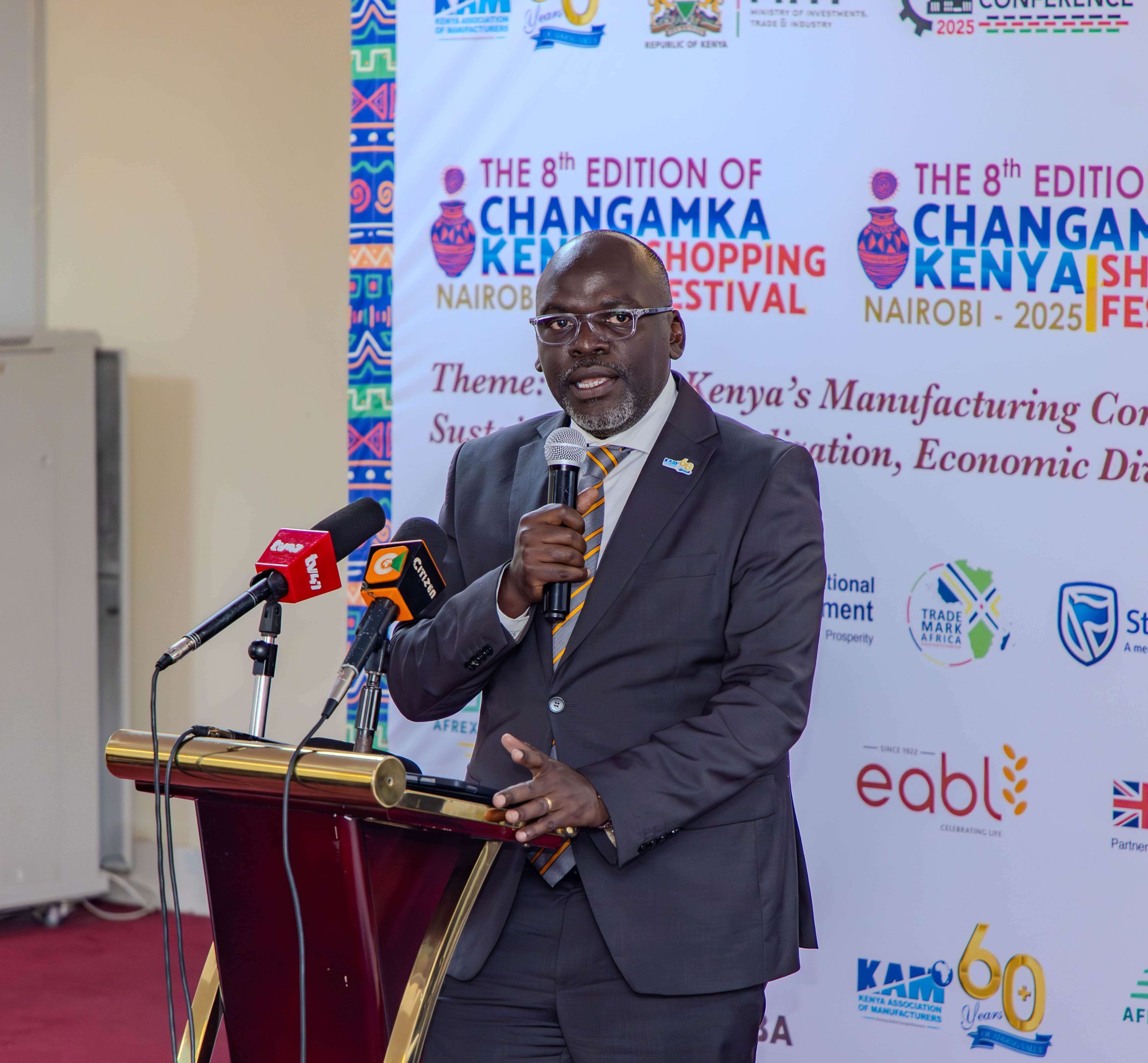
 On his part KAM’s CEO Mr. Tobias Alando, affirmed that revenues generated by the Festival have not only increased, indicating growth over the last few years, but also enhanced more partnerships and networking between big firms and SMEs and event international companies. He emphasized that the Festival has evolved into a powerful national platform connecting manufacturers, consumers, policymakers, and investors.
“Since its inception eight years ago, the Changamka Festival has become a powerful platform for connection, bringing together manufacturers, consumers, policymakers and investors under one roof. It has grown into the pulse of the ‘Buy Kenya, Build Kenya initiative’, showcasing the diversity and high quality of products made right here. What makes Changamka special is that it gives Kenyans a real chance to see what local industries can do, to meet the people behind the brands and to appreciate the innovations that drive our manufacturing sector forward,” Mr Alando affirmed.
The current uncertainty in Tanzania, an important Kenya trade partner in the EAC, following recent presidential & parliamentary elections was an issue of concern to the Media present at the event. “This is a matter of big concern for all of us in the EAC and we must all work to restore peace in Tanzania and our other neighboring countries. Peace and stability is good for all of us. Sadly, currently, our trade with Tanzania is very adversely affected. Logistics including transportation through road and air is also disrupted,” he rued. According to Mr Alando, Kenya exported products (goods & services) worth sh 67 bilion (B) to Tanzania and imported products worth sh 57 B from Tanzania in 2024.
The festival attendees got chances to engage directly with local producers, explored new innovations, and experienced firsthand the quality of 100 per cent Made-in-Kenya products. Beyond Nairobi, Changamka has also expanded its reach to other regions, with successful editions held in Mombasa and Kisumu.
For instance, the 5th Mombasa Edition, held in July 2025, attracted thousands of visitors and highlighted the coastal region’s growing role in driving industrial growth and trade connectivity. The Nairobi 8th festival was complemented by the 3rd Kenya Industrialization Conference from 5th Nov 2025 also hosted at the KICC. The conference gathered policymakers, industry leaders, investors, and development partners deliberating on strategies that aligned with this year’s theme. The discussions focused on policy reforms, trade partnerships, and means to enhance the competitiveness of Kenyan products in regional and global markets.
The Shopping Festival 2025 succeeded courtesy of support from key partners and sponsors, including the UK International Development (FCDO), TradeMark Africa (TMA), Afreximbank, Stanbic Bank, NCBA, and Network International organizations committed to advancing Kenya’s manufacturing competitiveness and regional trade integration.{Ends)