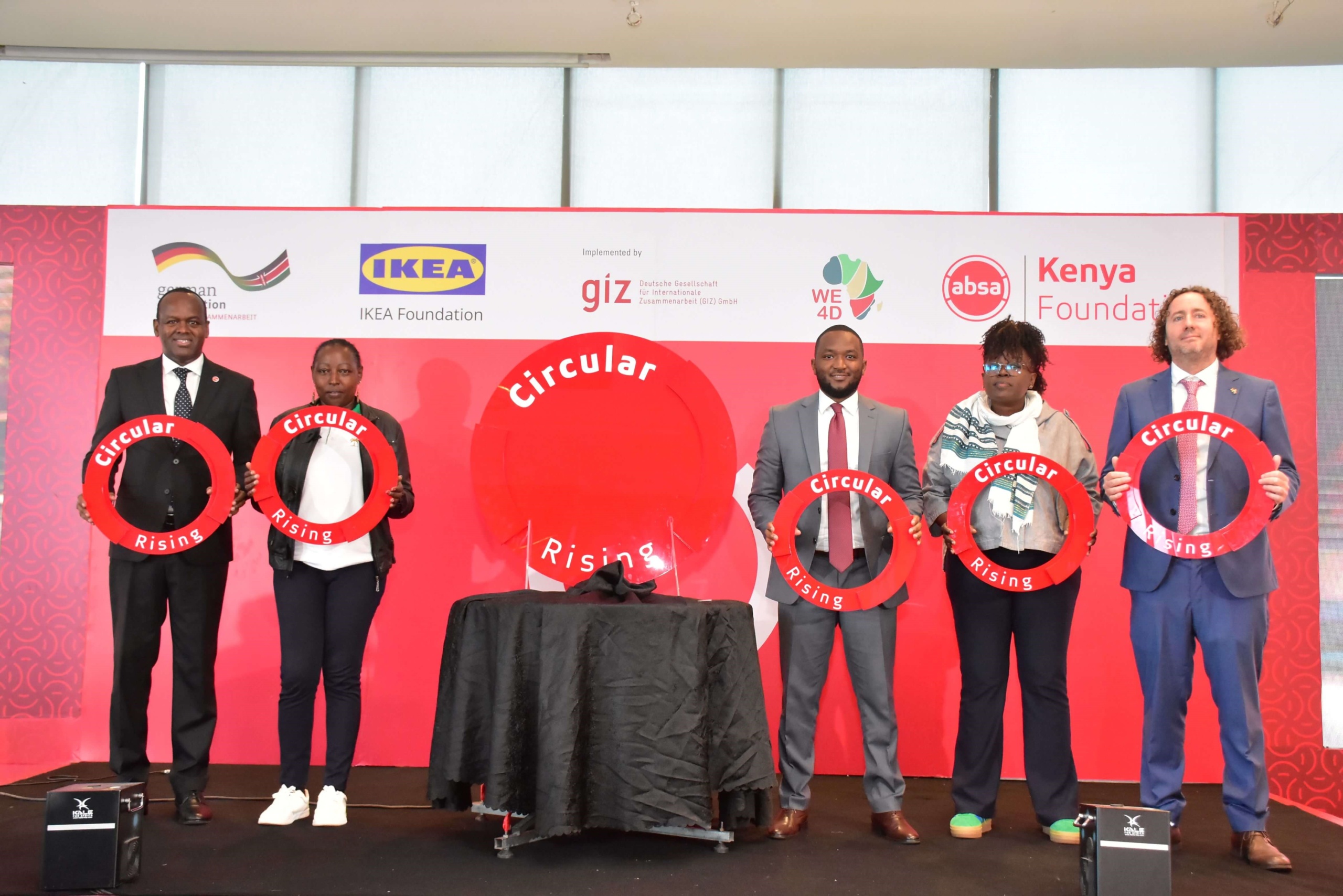
Absa Kenya Foundation and GIZ Launch Kenya’s First and Largest Circular Economy Program
A transformative initiative that aims to reach and empower more than 2,000 women- and youth-led Micro, Small & Medium Enterprises (MSMEs) operating within Kenya’s circular economy and with a capacity for recycling over 6,000 tonnes of waste and thus positively impacting more than 30,000 lives indirectly has been launched in Nairobi, Kenya. An initiative of Absa Kenya Foundation, in partnership with the German Corporation for International Cooperation (GIZ) and the African Guarantee Fund (AGF), this is arguably Kenya’s first and largest CirculaRising Program, targeting the creation of over 6,000 new and improved jobs in the next two to three years, it was reported in Nairobi on April 30th, 2026.
According to the partners, the program’s overall objective is to promote and integrate circular solutions and gender-inclusive strategies within the circular economy, contributing to sustainable growth, environmental conservation, and inclusive economic development.
At the launch event, Absa Bank Kenya’s MD & CEO, Abdi Mohamed, acknowledged the role of partnership and noted that this initiative is a collaborative response to one of the most defining economic questions of our time–how economies can grow without exhausting the very resources that such growth depends on.
“For decades, global growth has largely followed a linear model where we take, make, use and discard. While this model has delivered progress, it has also generated enormous waste, placed immense pressure on natural systems, and widened inequality in how opportunity is distributed. The next chapter of growth will belong to economies that create value differently. Economies where waste becomes input, efficiency becomes advantage, and sustainability becomes enterprise. That is the opportunity the circular economy offers, and what underpins the launch of this initiative,” affirmed CEO, Abdi Mohamed.
Notably, the program is co-funded by the German government and IKEA Foundation and will be implemented by the Deutsche Gesellschaft für Internationale Zusammenarbeit (GIZ) GmbH, and its partners through three tailored phases to address the diverse needs of MSMEs. The CirculaRising Academy, fully funded by Absa Kenya Foundation will target over 2,000 microenterprises through training, coaching, market access, and financing support over 27 months.
On the other hand, the CirculaRising Accelerator component, implemented by GIZ will support 150 growth stage small enterprises across Nairobi, Central, Western, Nyanza, and Coastal regions through capacity building, market linkages, and access to finance. Additionally, the CirculaRising Scale-Up component will target 25 to 30 medium- and large-sized enterprises that generate high volumes of waste and intend to scale their export operations.
These enterprises will receive tailored training and coaching to support the development and integration of circularity and gender-responsive practices, as well as certification in global sustainability standards.
“With CirculaRising, we combine the empowerment of women’s employment with the scaling of circular business models in Kenya. Together with the Absa Kenya Foundation, we will support MSMEs in achieving economic, social and environmental impact, from increased employment and better incomes to improved recycling and waste management practices. This cooperation combines financial and advisory expertise to promote women in green value chains and to drive the transformation of the Kenyan economy,” explained GIZ’s Employment promotion for women for the green transformation in Africa (WE4D) program Kenya team leader, Thomas Jaeschke.
Mr Mohammed Doyo, the MSMEs Secretary represented Susan Mang’eni, PS State Department of Micro, Small and Medium Enterprises Development. Ms Mang’eni underscored the importance of MSMEs in Kenya’s economic transformation and reaffirmed government’s support for such initiatives.
“MSMEs remain the backbone of Kenya’s economy. Initiatives such as CirculaRising are critical in unlocking their potential, enabling access to finance, and supporting their transition into sustainable and competitive enterprises. As government, we are committed to creating an enabling policy and regulatory environment, strengthening enterprise support frameworks, and working closely with partners such as Absa to scale programs that drive inclusive growth, job creation, and long-term economic resilience,” observed Hon. Mang’eni.
On the other hand, Dr. Selly Kimosop, the Environment Secretary, on behalf of the PS, Environment and Climate Change, Dr. Eng. Festus K. Ng’eno, highlighted the role of MSMEs in the circular economy in advancing climate action and economic development.
“The transition to a circular economy presents significant opportunities for Kenya, particularly for MSMEs. Programs such as CirculaRising are essential in supporting green enterprise development, reducing waste, and driving climate action at scale in our country,” observed Dr. Ngeno.
The Africa Guarantee Fund (AGF) Group Director of Capacity Development, Patrick Lumumba, was also present at the event. “Despite owning 40 per cent of all MSMEs and contributing up to 20 per cent of the country’s GDP, women-led enterprises continue to face significant barriers, with an estimated 70 per cent lacking access to adequate financing and only 7 per cent having formal access to financial services,” Lumumba observed.
According to him recognizing the critical role women entrepreneurs play in driving Kenya’s economy, including in green value chains, the partnership between AGF, GIZ and Absa Kenya leverages the Affirmative Finance Action for Women in Africa (AFAWA) initiative to bridge the financing gap that MSMEs and more so, women-led MSMEs face. “Through the SHE Academy Program, Absa Kenya and GIZ reaffirm their commitment to empowering women-owned MSMEs as catalysts for change, fostering inclusive growth, and strengthening Kenya’s economic resilience,” Lumumba further affirmed.
The program aims to mobilize over K sh 302.6 million (M) (2 M EUROs) by 2028 in financing while delivering measurable environmental impact by redirecting 6000 tonnes of waste through reduction, reusing, repair and recycling
Remarkably, the Absa Kenya Foundation is anchored on four key pillars– Entrepreneurship, Education and Skills Development, Natural Resource Management, and Health and Humanitarian Relief, with CirculaRising directly advancing three of these pillars. The program reflects Absa’s purpose of empowering Africa’s tomorrow, ‘together, one story at a time,’ through supporting entrepreneurs, strengthening businesses, and driving sustainable economic transformation across Kenya.{Ends}