The arduous efforts behind the easy availability of ready chicken at different retail outlets:
Kenchic’s Thika Gatuanyaga plant:
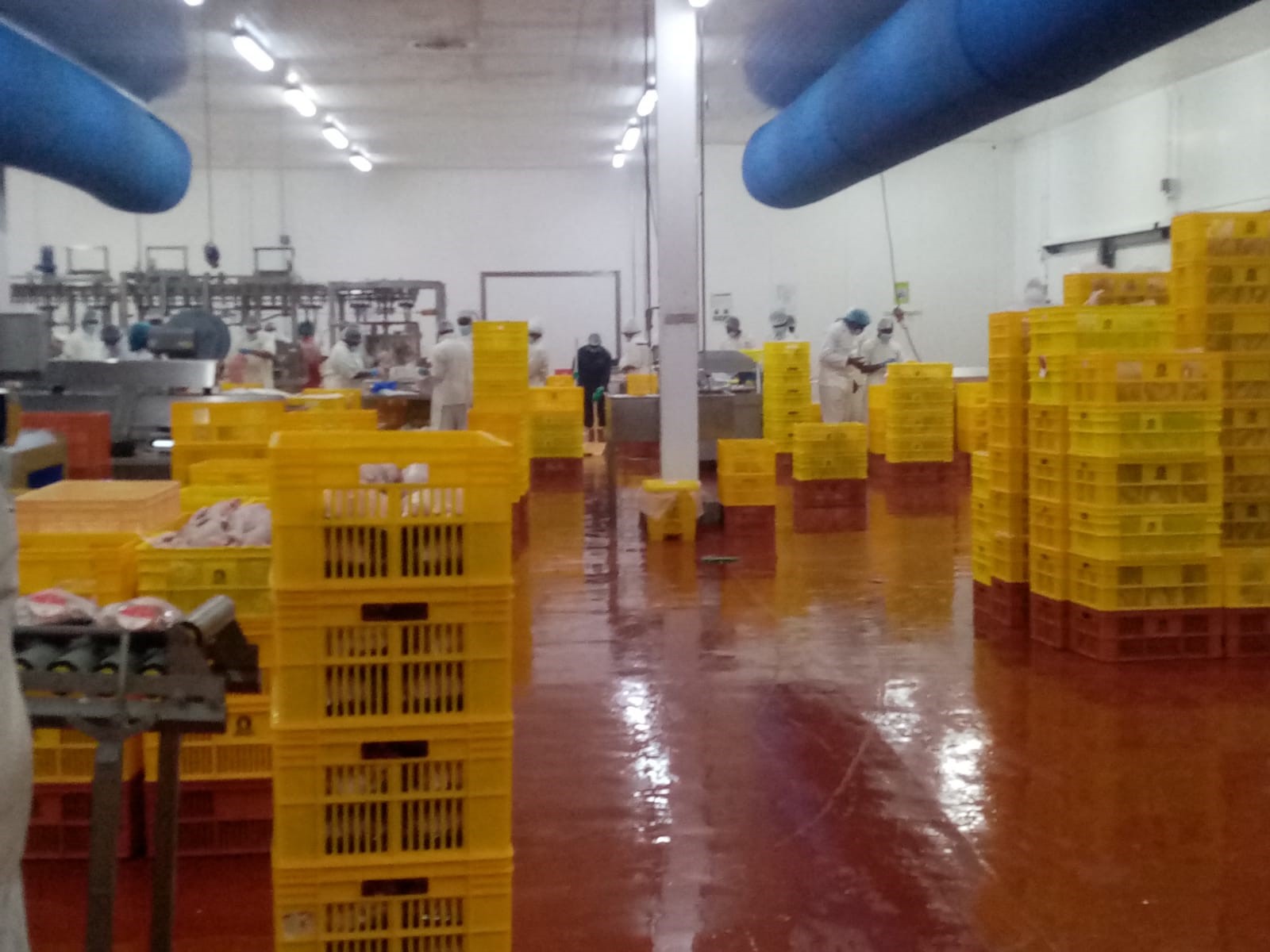
Customers and consumers of packaged chicken among other meat forms, readily available at different retail outlets, may never really and fully understand and appreciate the efforts and pains behind preparing their delicacies. My perception of this reality was shaped after I got privileged to join a United Nations Industrial Development Organization (UNIDO) team (approximately 60 persons) in an exclusive tour of Kenchic Plc’s (Kuku Mfalme), Thika Chicken Processing Plant on November 26th, 2025.
 Just prior to start of the tour, Kenchic PLC’s Head of Plant & Butcheries Operations, Mr Alun Maskell welcomed the guests and provided a brief review of the operations that daily occur at the Plant including the safety requirements to be observed. Anybody accessing the plant must first be sanitized at almost all the Plant’s access points. Even vehicles accessing the Plant have to be sprayed with a sanitizing agent right at the gate and especially their underside and whole body. A brief video expounded the Plant’s operations’ nitty gritty. As a rule, all accessing the facility must wear personal protective equipment (PPE) including hair nets, nose & mouth masks, dust coats and gumboots. They should not carry lose items such as pen’s lids which could drop inside the plant.
As the main subsidiary of the Africa Poultry Development Limited (APDL) Group (incorporated in Mauritius and operating integrated poultry companies in several African countries) in Kenya, the Plant slaughters 78 birds per minute. Remarkably, the plant is almost 100 per cent automated right from when the birds arrive at the grading line in crates (about 2500 crates are delivered daily in specially designed Lorries) to the section where meat cutting, grading & packaging is done. Once the birds arrive at the slaughter section, they are put on a line which exposes them to ultra-violet rays which relaxes them in order for them to stop flapping their wings. “As natural creatures, some of the birds are big and weigh more kgs while others are small or tiny despite being fed on the same diet,” explained Maskell in an interview after the Plant tour.
 In a predetermined line, the relaxed birds are then directed to automatic pluckers (for de-feathering) and then to the stage where their throats are slit. In the Evisceration room (EV room), the birds are opened up and internal organs (viscera) are removed. The chicken are then sprayed with bile water for relaxation of the carcasses then cooled to 8 degrees Celsius then below 5 degrees Celsius to await processing on day 2 in the Cut-up area. Here, the birds are broken up into several areas which essentially include leg & breast meat and wings (this consisting of only 10 per cent meat). To meet customers’ specific need such as orders for sausages and salamis, some of the meat parts including neck and internal organs such as liver and gizzard are further processed. Even the bones and skin are processed further. The bones can be grounded and mixed with spices and are then blend into sausages and put into edible ‘joe’ casing.
Kenchic PLC (under the maxim Kuku Mfalme) essentially packages among others prime cuts that include boneless, skinless thighs and breast meat (which has no connective tissue and is lean and very healthy). It also packs assorted cut and some cut meant for soup with such prime cuts being very pricy according to Mr Maskell. The above chicken parts can also be grounded into cubes and processed for salamis or drumsticks.
“Cold chain is very important here and is done continuously given that 70 per cent of our products are sold fresh; it normally starts at 5 degrees Celsius. We’ve two 25 Metric tons (MT) blast freezers for quick cooling after which the chicken is placed in holding freezers. We have two holding freezers with 150Mton capacity each,” Maskell expounded. Essentially, the Plant is under 24 hours chilling where cooling is necessary with the temperatures even reaching 2 to 3 degree Celsius when the products are ready for delivery. In the cutting areas, the temperatures are maintained at 12 degrees Celsius. In some two cold stores, the temperatures even dip to minus 18 degrees Celsius.
Value-added products: These include sausages and other cooked products as guided by clients’ & customers’ specifications and needs. Sausages making is complex; they are a blend of ground chicken, fat, soyas and spices stuffed in joe casing a natural product. The sausages are then cooked, dried, chilled and packed ready for delivery to customers. The cologne casing on the other hand is used to make fresh- use sausages. The Hungarian spices 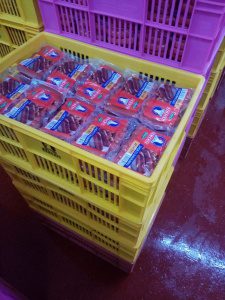 chicken sausages are very popular.Cooked products include, as aforementioned, salamis and hams. The chicken parts are softened according to customers’ needs and recipes. Salamis in particular can either be sold fresh or frozen.
Innovation: Innovation is very pronounced at the Plant with operations being over 70 per cent automated. Modern equipment and machines are in place for fast cooking of the chicken parts as is required and for fast chilling as required. Smoking of sausages prior to innovation, for instance, used to take six hours; this is now done in one hour & 50 minutes. Prior to innovation, production stood at 1MT per person per week; innovation, courtesy of technology, has raised this to 3MT per person per week. The process from live chicken delivery to meat delivery takes about 90 minutes with slaughtering taking 20 minutes; removal of internal organs in the EV room 40 minutes followed by chilling though ideally, the chicken is chilled ( in a temperature drag) overnight.
“Regarding automation among other quality & standards requirements, we’re certified over and above Kenyan standards. We’re passionate about standards and food quality and we’re dedicated to ensuring very high standards,” Mr Maskell averred. On quality control (QC), the Plant takes pride in a QC army of 16 persons. Thus, the products are traceable through a bar-code right from the egg stage. In a normal week, from Monday to Friday, about 235,000 birds are slaughtered at the Plant this translating on average to between 37,000 to 42,000 birds.
Export markets? The Plant is essentially keen to first meet and satisfy Kenya’s meat and protein demand given fears that there is a deficiency. Nevertheless, the Plant sends its products to sister firms in Uganda and Tanzania by road. “Though we manage 16 chicken growing farms that are supplemented by 18 out grower farms, we can’t do enough birds and there is still a deficit in meeting the demand,” Mr Maskell confessed. According to him local demand 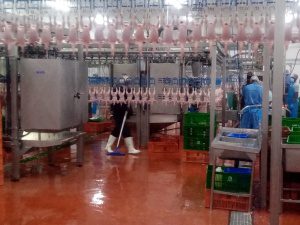 and in the neighboring counties is far from being satisfied. “We don’t have any surplus for export except the two truckloads to Uganda and one truckload to Tanzania for our sister firms. Since we supply Carrefour Supermarkets, we expect that our products will reach other African markets into which the supermarkets chain is expanding,” Mr Maskell explained.
Like in Europe and other parts of the world, the birds in Kenchic’s and out growers’ farms are fed on special diets as per nutritionists’ guidance. As a rule of nature, all the birds cannot attain the same weight despite being fed similarly so the Plant often receives birds weighing 1.73 kg to 1.77 kgs with some (a few) attaining 1.8 kgs weight but with 80 per cent of the birds being in the 1.2 kgs to 1.5 kgs category.
The Plant also hosts several government veterinary officers (Vets) who check internal organs of the slaughtered birds, in order to identify issues that could arise, and also ensure that the Plant complies with health & hygiene requirements.
High and tight hygiene and cleanliness standards are adhered to with the Plant spending K sh 3.5 million (M) on cleaning per week and K sh 2 M per week on maintenance work. The Plant extracts water from the nearby Chania River and pumps the water to its treatment plant where the treatment processes prepares it ready for use. The plant uses between 500,000 litres and 700,000 litres of water daily but on average 600,000 litres for the slaughtering and other cleaning activities. On average each bird uses 15 litres from the first to the last stages ready for packaging and delivery. All the effluent used is collected into an underground treatment plant that cleans it and removes salts after which it is pumped into the riparian areas near Athi River which is adjacent to the Plant. Compared to Athi River water, the Chania River water is cleaner.
Courtesy of the Plant, 267 jobs have been created with 180 persons working inside in various departments such as customer service, logistics, security and maintenance where engineers work round the clock to maintain boilers, and refrigeration & electrical/electronic equipment. The Plant manages 54 trucks for delivery and related tasks. Mr Maskell avers that every single machine operator at the Plant is well trained and equipped to remain alert and to identify any problems that could present in the machines and equipment and then report to the engineers in charge. “We’ve trained our staff, and especially technicians, to understand the products, equipment & machines and processes. We’ve also instilled passion in them to work wholeheartedly and diligently,”Mr. Maskell explains.
 Sustainability ethos & pillars: Guided by its Core values—Team Work (Players); Commitment; Excellence & Responsibility, the Plant ensures optimal use of resources for the best productivity. Its sustainability ethos ensures minimal waste disposal. As aforementioned all effluent is treated and released to the environment safe for use. The chicken blood (very rich in protein) and heads are bought by pig and dogs breeders while feathers are bought by insect breeders and are used to manufacture organic manure. The intestines are also stripped and bought by pig farmers.
A long career in food production: Mr. Alun Maskell is a Briton originally from the UK. “I came to Africa in 1988 and have worked in Sub Saharan Africa (SSA) in different countries including South Africa for long. I studied Meat Science and I’m a fully qualified Meatmaster. When I reached Kenya, I found Her people very hungry for information and so keen to learn. Kenyans are like sponge when it comes to absorbing knowledge and new ideas,” Mr Muskell says of the Kenyan people. “I can affirm that no one should stew fillet meat since all meat that has connective tissues should be cooked in special ways,” he jokingly says in conclusion. {Ends}