Passionate and committed to giving back to Society; Ramla Ali, retraces childhood journey in Kenya
Society:
“Aid supported me and my family when we escaped from war in Somalia and I shall never forget the help. This is the reason why I love giving back to Society and especially helping the girls, women and other people in dire situations in the Dadaab refugees’ camp,” Ramla Ali affirmed when she met her fans, guests and journalists on September 12th, 2025 at the Unseen Theatre in Kilimani Nairobi.
UNICEF and partners in the Ifo Child Friendly Space offer art therapy and indoor and outdoor play to support emotional healing and resilience.
Ramla Ali is a British Somali boxer, an Olympian and a model. As the UNICEF UK Ambassador, she recently visited Kenya with UNICEF to retrace the steps her family took when fleeing Somalia’s conflict during her childhood. A visit to the Dadaab refugees’ camp also allowed her to meet girls attending school in one of Kenya’s biggest refugee camp, many of whom have been impacted by recent funding cuts, especially from the USA government, to overseas aid.
Ali was born in Mogadishu but her family left when, tragically, her brother was killed by a grenade. As a refugee in Kenya, her mother recalls queuing for food aid. Ali was a toddler when the family were granted asylum in the UK. She went on to excel at boxing on the global stage.
“I’ve seen first-hand that aid really works but unfortunately decades of progress for children around the world is being undone because of aid cuts,” regrets Ali who is supporting UNICEF’s calls for protection of aid spending for children.
Ali’s boxing journey:
She started as an amateur boxer only 12 years old but has now graduated into professional boxing. According to Richard Moore, her Briton manager and husband, professional boxing (especially for women) has its own share of challenges and is not as lucrative as people would expect. It involves about three to four months of training and then competition as per several boxing seasons in different parts of the world and its emoluments enables the competitors to merely meet their basic needs. To complement her boxing competitions and especially in order to get funds for helping others in Society, Ali also does modelling for different organisations and magazines cover.
“I was particularly keen to compete for Somalia in order to inspire girls in the country. A friend, Mr Hassan, helped me a lot in reaching out to the government and to generally navigate to be able to represent Somalia. Today, girls in Somalia have big dreams and I encourage them to believe that all dreams are valid,” Ali asserted. “I was inspired by Mohammed Ali and my message to the girls in Somalia (who now hold dreams) is that they can do anything they put their minds to. At the Dadaab camp, I experienced love like I’ve never experienced before and I’m very inspired,” she asserted at the recent event.
Ali has competed in the Tokyo Olympics and has fought for the world title in boxing. She is the first person, male or female, to have ever competed in boxing at the Olympics for Somalia and the first woman in history to have ever competed in boxing in Saudi Arabia. Her recent win in Madison Square Gardens in June 2025 was one of the biggest ever female boxing sports events live on Netflix.
According to Ali, film is important as it shows people what happens in the world including in refugees’ camps. She spoke just moments prior to a short and confidential screening of a new Hollywood film about her life, titled ‘In the Shadows’, and which will be released next year (2026) marketed by the team behind Moonlight and from the producers of the Oscar winning Best Picture, ‘The Favourite’ and BAFTA winning ‘The Lobster’. Jasmine Jobson who played Jaq in Netflix series Top Boy will play Ramla.
‘The Sisters Club’ whose idea she mooted in 2018 and which she soon after founded, supports 13,000 women annually with free running, basketball football, & boxing and self-defense classes. “I dedicate one hour a week to meet women, especially those who have never had a chance to get the right education. In London, which has a huge Moslem community, I’ve met many women some of whom have suffered domestic violence and we’ve taught them boxing which could be used as a form of self-defense,” Ali added.
Ali aspires to become a boxing champion in the near future and also plans to visit to her country of birth seeing that she has never returned after the war situation that led to her family’s fleeing from the land.
Tough Life in refugees’ camps:
UNICEF officials at the event revealed that Kenya hosts about 850,000 refugees with almost 432,000 being hosted at Kakuma refugees’ camp and over 400,000 others at Dadaab. Notably, 50 per cent of all the refugees are children. Several problems confront refugees in the camps including limited water supply which affect sanitation negatively.
According to UNICEF, the recent cut in aid spending by the developed countries, particularly, has started adversely affecting life for refugees. In Water & Sanitation, for instance, water supply has reduced given that the lack of funding has led to fuel shortage for borehole generators, reducing pumping hours and leading to a sharp decline in water availability in the Dadaab camp. Hence, refugees are receiving less than half of the water recommended (they are now getting 8.5 litres contrasted to UNHCR’s minimum emergency standard of 15-20 litres per person per day. Resurgence of cholera is a concern (connected to lack of clean water and sanitation). The health, dignity, and survival of over 300,000 refugees are at risk.
In Health & Nutrition, there are now fewer health workers and health supplies, a reality that has weakened the capacity to respond to the population’s health needs. On the other hand, reduced food rations are exposing more children to risk of malnutrition.
In Education, (it is commendable that the Kenya government has now recognized schools in the camps as part of the country’s education eco-system), lack of teacher’s salaries funding has led to lay-offs, compounding a situation where teachers are already in short supply in the camps. Reduced water supply at school levels is leading to absenteeism and risks of children dropping out too.
Additionally, Child Protection has suffered given that there are fewer child protection case managers in the camp leading to less capacity for children protection and response to their physical & mental health or economic needs. Reduction or ending of many families’ “Cash Grants” lifelines (monthly financial support for vulnerable refugee families) may lead to negative coping mechanisms, such as child labour, child marriage, and school dropouts, increasing children’s risk of exploitation and long-term trauma.
Already Child marriage, FGM (female genital mutilation) and abuse of many other children’s rights including access to education are evident in the camp and can often can lead to unrest.
Yet, UNICEF (which essentially relies on voluntary contributions from governments, institutions & foundations and individuals) remains part of some innovative solutions that help children to catch up with the schooling they may have missed and to re-enter mainstream education. Already, UNICEF has sounded an alarm that reduced government spending in education many lead to dropout of about 2.5 million children in the country.
UNICEF has also warned that education budget cuts mean that an estimated six million additional children could be out of school by the end of 2026, around one-third of them in humanitarian settings such as refugees’ camps et al. Further, UNICEF fears that owing to aid cut, children will die from entirely preventable causes – not only malnutrition—that result from lack of clean water, safe sanitation and essential health services.
Countless more will miss out on education and programmes that protect them from harm and abuse. A brief video clip at the event detailed how the AEP (Accelerated Education Program) helps in refugees’ education including in compressing the eight years in primary education in the former 8:4:4 curriculum to four years. One of the teachers in the video is a beneficiary of the AEP.
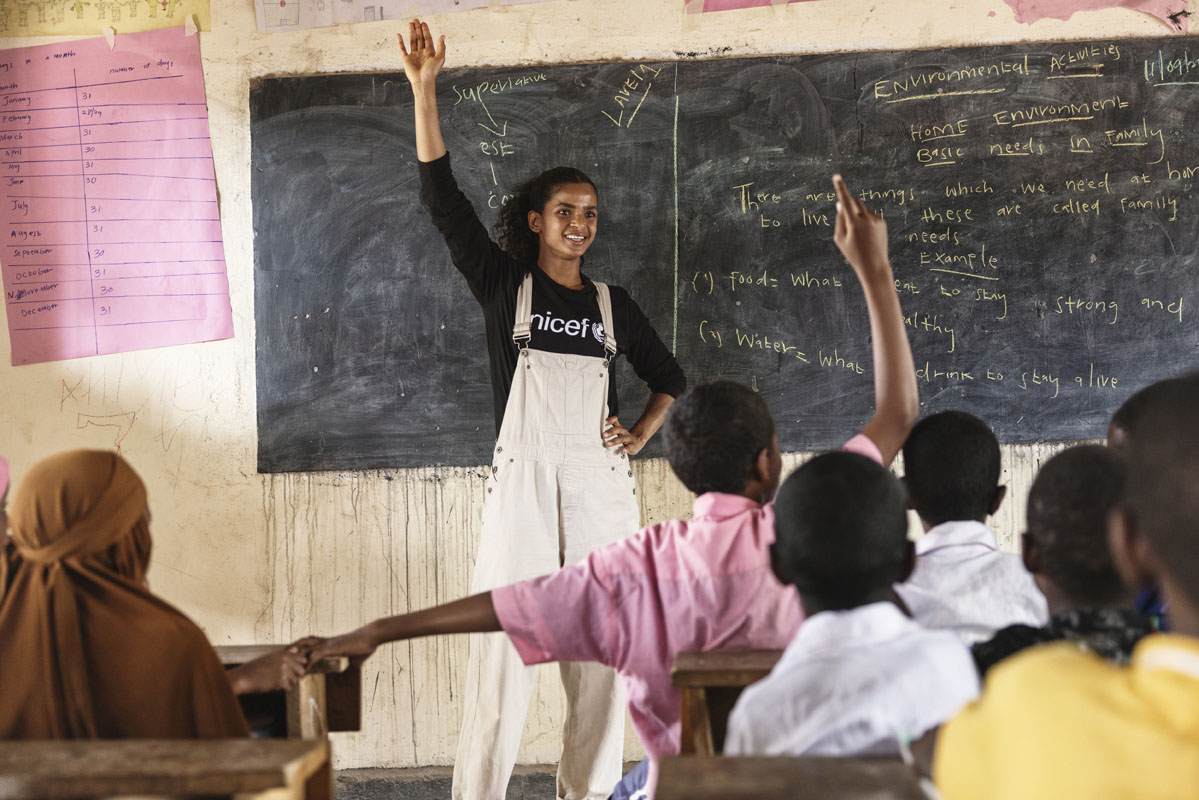
During her visit to Dadaab, Ali remarkably, met girls who are excelling at STEM (science, technology, engineering & mathematics) and breaking taboos and expectations. She met Head Teachers who rescue and intercept girls from forced marriages and support them to stay in school. “During my time in Dadaab I’ve observed how vital education is,” continued Ali. “It provides opportunity, hope and a voice for these girls, but being in school also means they are protected from violence and exploitation. Cuts to education funding will impact a girl’s safety and her entire wellbeing. The world’s most vulnerable children can’t be the ones to bear the brunt of funding cuts,” she rued.
During the recent Ali’s meeting with fans and Media, UNICEF averred that her story is one of great inspiration to girls. “This story proves that all girls’ dreams are valid. It’s a story of power and determination; from one who was a refugee to one practicing boxing in the UK and other parts of the world,” a UNICEF official was quoted affirming.{ENDS}