

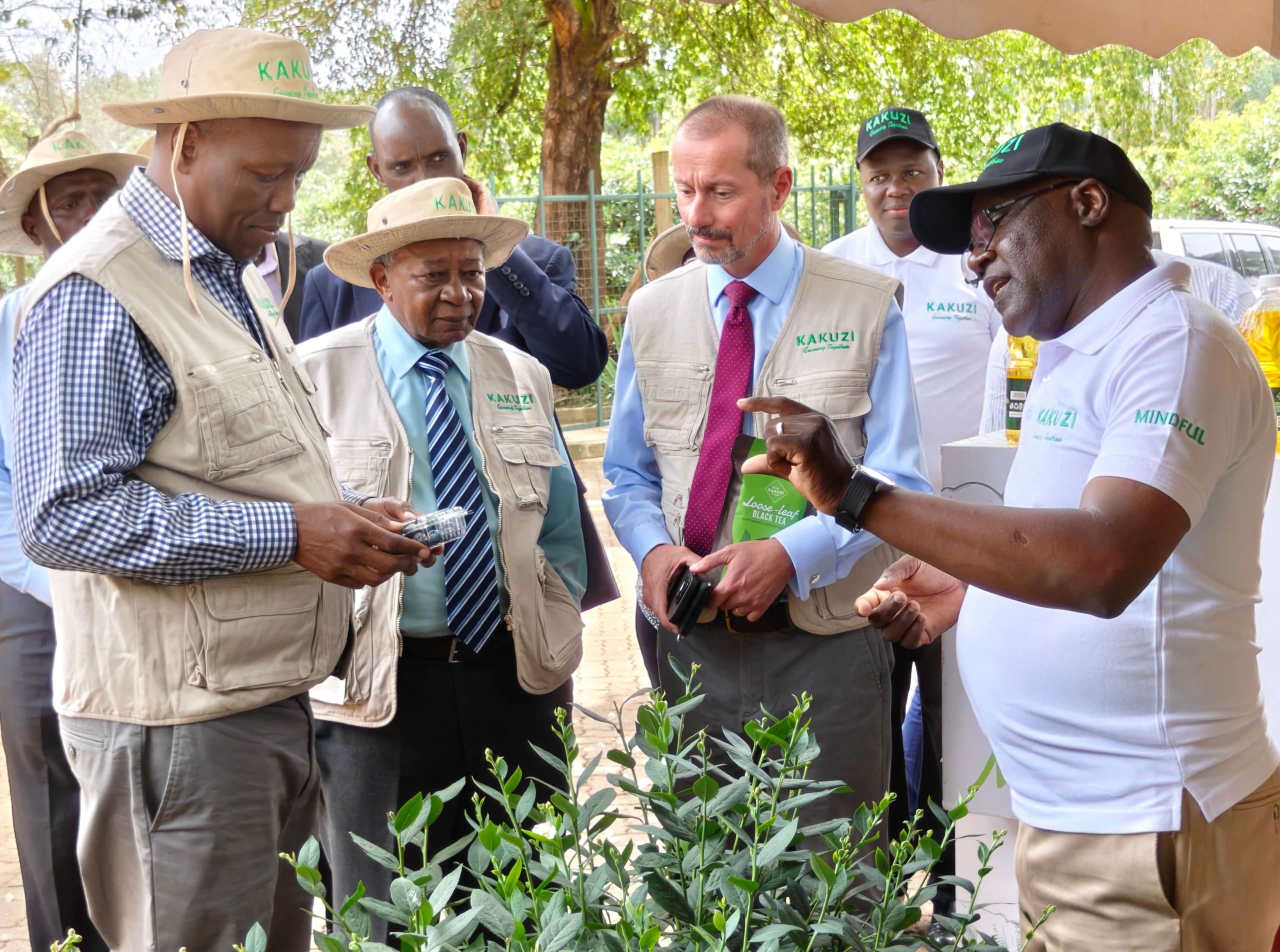
Kakuzi recaptures profitability and provides double dividends for shareholders
24/03…Listed agribusiness and super foods grower, Kakuzi Plc, has posted a K sh 387.5 million (M) after-tax profit, marking a significant turnaround from the K sh 131.6 M after-tax loss booked in 2025 indicates the company’s 2025 full-year financial results released on March 24th, 2026.
The firm’s Board of Directors, buoyed by the firm’s profitable run last year, has also recommended a first and final dividend of K sh 16 per share, double the payout for 2024.
From total revenues of K sh 5.4 billion, Kakuzi, a leading grower of Avocado, Macadamia, and Blueberry super foods, posted a K sh 568 M pre-tax profit, up from the Ksh 167 M pre-tax loss in 2024.
According to Kakuzi Plc Chairman Mr Nicholas Ng’ang’a, while certain circumstances that led to the loss in 2024 have been mitigated, geopolitical tensions continue to negatively impact the firm’s flagship avocado operations.
To mitigate losses, Kakuzi MD Mr Chris Flowers said the firm is actively rolling out a products-and-market diversification strategy, among other efforts to accelerate growth.
“For example, as an agricultural company, we’ve expanded our irrigation water conservation capacity by adding 1 million M3 (cubic meters) of rainwater storage, bringing our total to 13 million M3. This key development further enhances our self-sufficiency in water tapped from water catchment areas in our farm,” Mr Flowers said.
According to Mr Flowers, these sustainability and business development initiatives demonstrate Kakuzi PLC’s commitment to integrating sustainable agricultural practices into its operations, which will be fundamental to the firm’s future success.
While describing the company’s performance as commendable on the back of tighter governance and sustainable business operations, Mr Flowers singled out the firm’s blueberry operations, which continue to indicate that, despite high establishment costs, the crop could significantly contribute to Kakuzi’s diversification strategy.
“As a part of our corporate strategy of product diversification, we continue to focus on value addition wherever it makes commercial sense. The strategy is paying off, and while Kakuzi was export-oriented in the past, we can now confirm that we have a growing domestic market contribution to the bottom line, with sales exceeding K sh 50 million,” he expounded.
Kakuzi’s domestic market revenue stream is enjoying steady growth from the sale of value-added products at the Kakuzi Farm Market, including ready-to-eat macadamia nuts, cold-pressed macadamia oil, avocados, and blueberries. This year, the firm has also recently added loose-leaf tea products.
Segmentally, Kakuzi avocado profits last year grew by 96 percent to K sh 709 M, up from K sh 361 million in 2024. Avocado export operations in the period under review, however, were negatively impacted by instability stemming from complex shipping logistics experienced last year. The Red Sea route reopened in the year; however, logistical instability on this route continues to cause fruit quality problems and lower prices.
Avocado production increased by 23 percent, but export volume was negatively affected by pest and disease pressure. “Pest pressure continues to intensify nationally as the area under avocado orchards increases. We, however, continue to work with the relevant partners to develop new techniques to proactively manage these emerging issues,” he added.
The European market prices last year were lower for the firm’s main Hass crop, due to substantial volumes from traditional suppliers Peru, South Africa, and, to some extent, Colombia. In 2025, Kakuzi exported 525 containers, up from 446 containers the previous year, achieving an average price of Euro 7.13 per carton.
The Company, he said, continues to develop mitigation measures, including leveraging market access to both China and India. “While these markets offer easier logistics, the current market size does not offer an immediate substitute for Europe,” Mr Flowers explained.
The firm’s Macadamia business posted better profits, closing at K Sh 365 M, up from K Sh 69 M the previous year.
Demand for macadamia, Mr Flowers observed, continues to recover, with increased sales volumes and improved prices. “However, to maintain sustainable demand, the product needs to expand the opportunities for how consumers can experience quality macadamia kernels,” he said.
The Kakuzi Blueberry operation recovered to a K sh 5 M profit, up from a K sh 19 M loss the previous year. Production volumes also increased to 90 tons, up from 53 tons.

